
WRX VB Wheel Fitment: 18x9 & 18x9.5
The VB deserves its own fitment plan. Compare an exact 18x9.5 reference with narrower 18x9 candidates, tire diameter changes and lowered alignment needs.
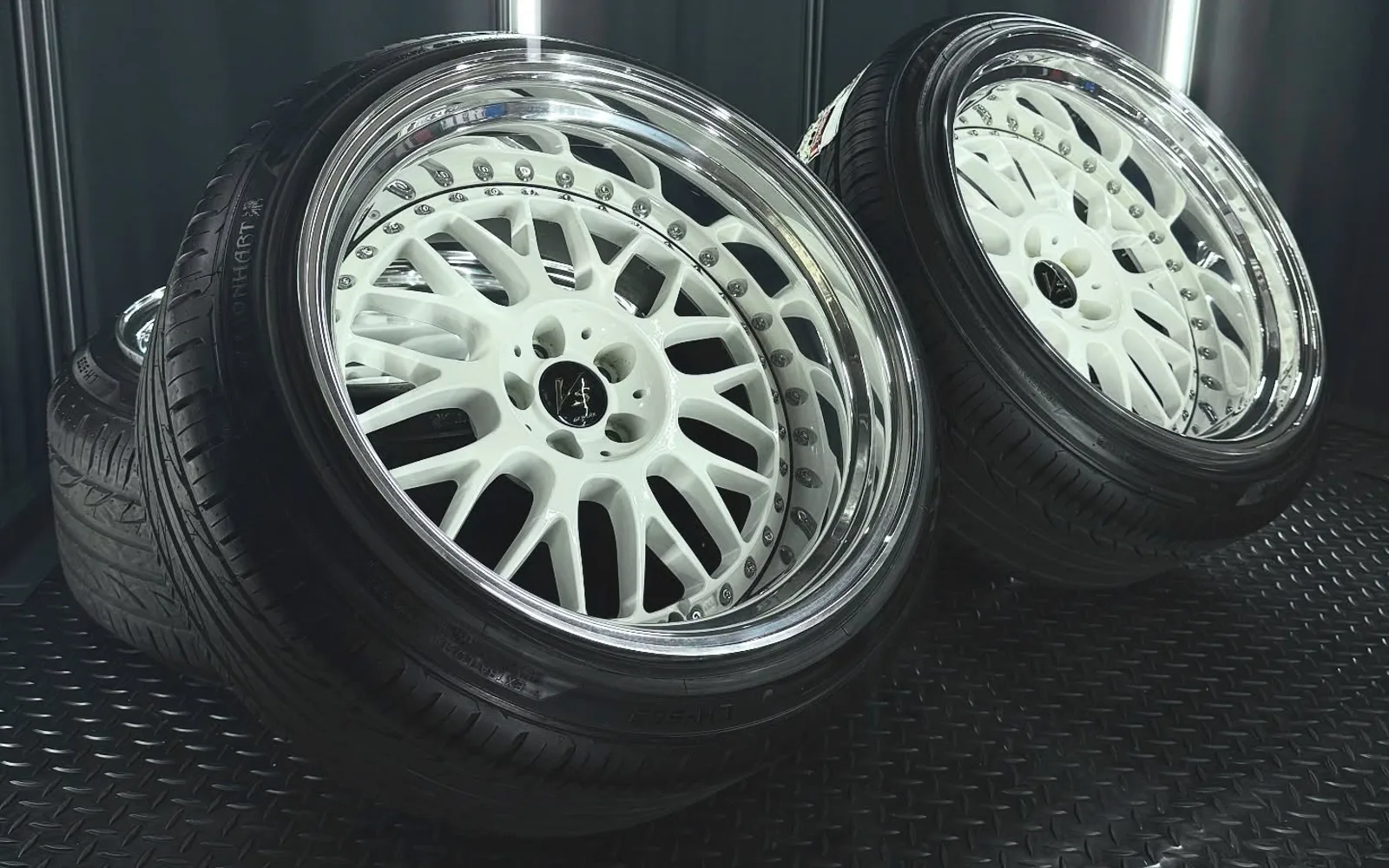
Quick answer: a documented VB starting reference
For the 2022+ Subaru WRX VB, Apex documents its SM-10RS 18x9.5 ET40 with Falken RT660 255/35R18 as a square example labeled Direct Fit. That statement belongs to that particular wheel/tire application—not every wheel stamped 18x9.5 +40, every brake trim or every lowered car.
Treat the VB separately from the 2015–2021 VA. Shared wheel mounting does not prove identical suspension-part compatibility or body clearance.
Wheel and tire reference table
| Wheel | Tire | How to use the example |
|---|---|---|
| 18x9, approximately ET40–45 | 245/40R18 or 255/35R18 | Narrower measurement starting point; verify tire rim-width range and both inner and outer clearance. |
| Apex SM-10RS 18x9.5 ET40 | Falken RT660 255/35R18 | Apex's documented Direct Fit example; verify your brake package, suspension and alignment. |
| 18x9.5 ET38 | 245/40R18 or 255/35R18 | ThreePiece retailer recommendation for stock/slightly lowered cars, not a universal clearance guarantee. |
An 18x9 wheel reduces rim width by half an inch compared with 18x9.5. At equal offset that gains about 6.35 mm on each side, but changing offset can give that clearance back. Consider width and offset together.
Offset changes versus the factory 18-inch reference
Circuit Demon cites 18x8.5 ET55 with 245/40R18 for an 18-inch-equipped VB. That is a trim-specific reference, not the specification for every VB.
Compared with that wheel, 18x9.5 ET40 moves the outer rim about 27.7 mm outward while gaining about 2.3 mm of inner rim clearance. These calculations describe rim position only. A different tire may still place its sidewall closer to the strut or fender.
Do not buy a spacer solely because a photo looks tucked. A spacer lowers the effective offset, requires appropriate fastening hardware and can create outer clearance problems even when it helps at the strut.
245/40R18 versus 255/35R18
The nominal diameters are approximately 653.2 mm and 635.7 mm. A 255/35R18 is about 2.7% smaller than a 245/40R18, which changes the indicated-speed relationship, effective gearing and wheel gap. Check the actual tire manufacturer's dimensions and your original specification.
Choose tire size for driving, load capacity, wet-weather needs and clearance—not width alone. The documented 255 example does not establish universal fitment for 265- or 275-width tires.
Lowering and camber: what is actually adjustable?
The front strut layout has limited factory camber adjustment. Compatible front camber plates can add range, but only kits that include them offer that feature. Racecomp's VB Superstreet 2, for example, lists front camber plates and its own lowering range; those product specifications are not a universal ideal ride height.
For rear camber after lowering, suitable adjustable lower control arms are a common solution. Rear toe requires separate attention, potentially with application-correct toe arms when factory adjustment is insufficient. Suppliers list VB-specific parts: do not assume every VA rear component transfers.
Lowering springs retain OEM-style front spring-perch constraints. Coilovers may change clearance, but the tire can still contact a spring collar. Set a practical driving height with bump travel, then align and test under compression. Avoid using excessive camber to mask an unsuitable wheel or tire.
Brake trims and swaps
Check the exact brake package, especially Brembo-equipped trims and aftermarket swaps. Spoke shape, mounting pad and barrel profile matter. A design that clears standard VB brakes is not automatically suitable for larger calipers, even in the same diameter and offset.
Coilovers, lowering springs, or bags?
Our preference: quality, application-correct coilovers over lowering springs when the goal is to dial in both height and fitment. Choose the kit for your car, intended use and damper travel—not just how low it goes.
Lowering springs usually set a fixed drop on compatible dampers. They do not add height or preload adjustment, and they retain OEM-style spring-perch clearance constraints. Check spring/damper compatibility and available bump travel. Springs alone do not give you adjustable camber.
Coilovers let you set ride height, but their adjustment mechanisms differ. Some use a separate lower mount to adjust length independently of spring preload; others change height through the spring perch. Do not assume every kit independently adjusts both. Follow the manufacturer's preload, ride-height and travel instructions. Damping adjustment and front camber plates are kit-dependent, too. A narrower spring can help inner clearance, but a collar next to the tire can still interfere.
Air suspension offers adjustable height and a parked low stance, but adds bags, lines, management, a compressor and a tank to maintain. Align the car at a repeatable driving height and check clearance at that height through steering and compression. An aired-out photo is not proof of safe driving clearance. Follow the exact kit's minimum pressure and travel instructions; never borrow pressure numbers from another chassis.
For a daily or track-oriented build, coilovers offer a simpler mechanical setup. For a show-oriented build where adjustable parked height matters, bags can make sense—provided the driving height, alignment and usable travel are treated separately from the parked look.
Before ordering: the clearance checklist
- Confirm year, chassis, body style, brake package and any hub conversion.
- Record wheel width, offset, bolt pattern, center bore and lug-seat requirements.
- Check the exact tire model's approved rim-width range, load rating and overall diameter.
- Measure inner clearance to the strut, spring perch, collar or bag; inspect outer fender and liner clearance.
- Test at full steering lock and through suspension compression, including passengers and load.
- Set ride height, then align camber and toe; recheck clearance afterward.
- Verify brake clearance with the wheel manufacturer's application chart or template. Diameter and offset alone cannot confirm it.
Fitment examples are references, not guarantees. Tire shape, wheel construction, ride height and alignment change the result. Send us your exact setup through Contact before buying if you need help checking a listing. All sales are final; confirm compatibility before checkout.
Shop a VB-ready build
Subaru wheels · Subaru suspension · Subaru exhaust. Confirm that the individual part specifically supports the VB before ordering.